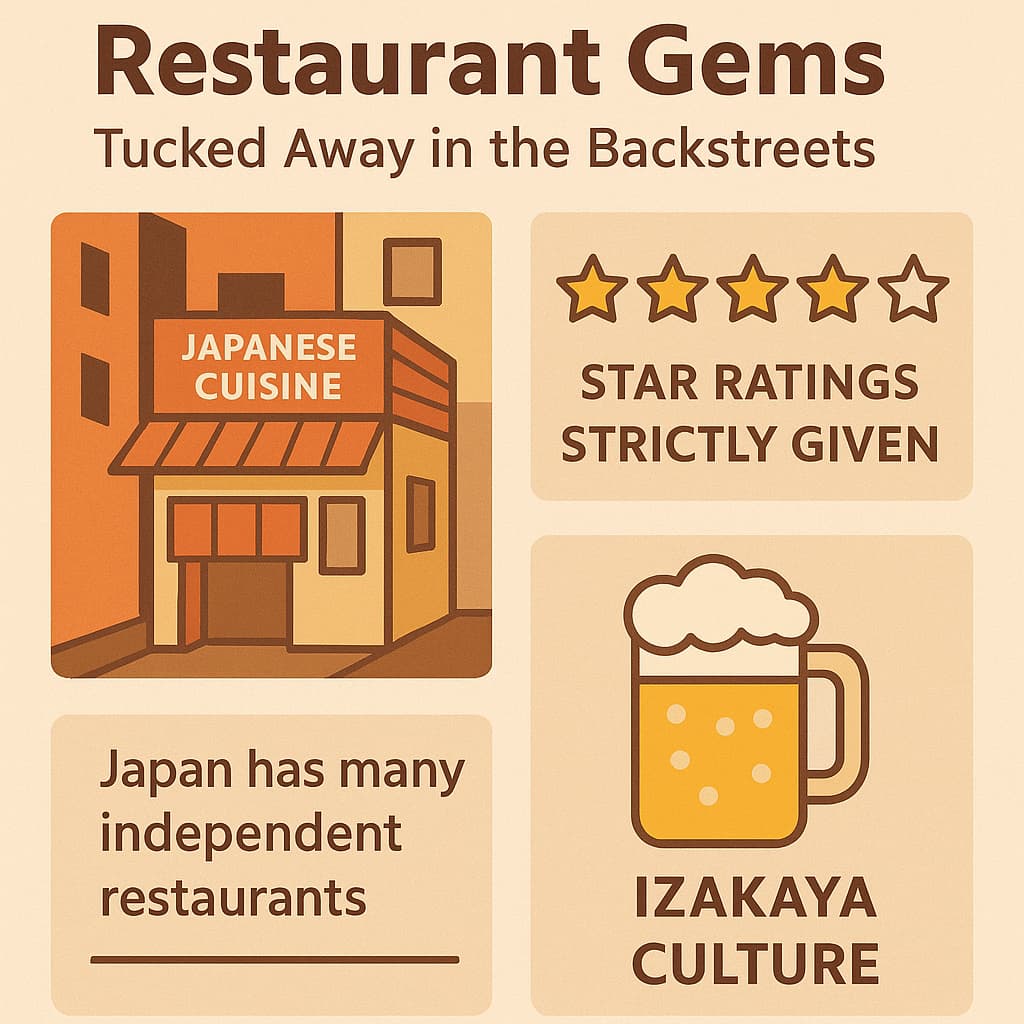
チェーン全盛の時代に生き残った“個人店の強さ”と
厳しすぎるレビュー(星評価)の読み解き方
関連記事
- 日本でやってみてほしい食べ物体験10選+1|海外旅行者向けリアルガイド
- 【海外向け】冬の日本で“やってほしいこと”リアルガイド
- 【旅行者向け】ホテル周辺でできる“日本ならではの小さな体験”ガイド
- 【旅行者向け】日本の外食文化ガイド|定食・食べ放題・コンビニ飯まで“失敗しない食事”の選び方
🏮 はじめに|海外ではなぜ“路地裏=危険”なのに、日本では宝庫なのか?
海外では「路地裏は危ない」「大通りの店が安全」という常識があります。
しかし日本ではその常識が真逆になります。
日本では“路地裏こそ名店の宝庫”。
個人店が大通りのチェーンと戦って生き残る“職人の生存領域”が路地裏にある。
そしてさらにややこしいのは、
日本のレビュー星評価(Google Maps等)が世界で最も厳しいという事実。
そのため、
“路地裏 × 星3.4〜3.8”が実は最強ゾーン
という、知らないと見落としてしまう“本物の名店”がたくさんあります。
この記事では、
- なぜ日本の路地裏に名店が多いのか
- なぜ星の評価が実態より低く出るのか
- どんな店が当たりやすいのか
- 観光客が知るべき「日本の星評価の読み方」
を丁寧に解説します。
🍜 なぜ日本の路地裏には“個人店の名店”が集まるのか?
日本の路地裏文化は、海外と比べてもかなり特殊です。
理由は以下の4つ。
✔ ① 大通りは家賃が高すぎる → 個人店は勝負できない
大通りに面した店舗は家賃が非常に高い。
→ チェーン店・大手資本だけが参入できる
→ 個人店は採算が取れない
→ 結果として 「裏路地」へ流れる
この構造が“路地裏=個人店の聖域”を作ります。
✔ ② 居抜き文化が強い → 小さな店でも開業できる
日本は「居抜き物件文化」がめちゃくちゃ発達しています。
前の店舗の内装・設備をそのまま使えるため、
小規模でも開業しやすい=個人店が増える。
裏路地の細いスペースにも店を構えやすいのが日本の特徴。
✔ ③ 治安が良い → 裏路地に人が流れる
海外では裏路地に入らないのが普通ですが、
日本では夜でも普通に歩けるほど治安が良い。
→ 人が歩く
→ 店が成立する
→ 個人店が根付く
この“治安の良さ”は、路地裏文化を支える最大の要因。
✔ ④ 個人店は「味」で勝負するから生存競争が激しい
チェーン店と違い、広告力も資本もない。
だからこそ
味・こだわり・常連の信頼だけで生き残る世界。
つまり
路地裏に残っている店=生き残った“猛者”
という誤解なき事実。
⭐ 日本のレビュー星評価は“世界で最も厳しい”
海外レビューと日本レビューは意味が全然違います。
実際、日本では…
✔ ⭐3.0〜3.4
→ 普通に美味しい(値段相応)
→ 海外なら4.0レベル
✔ ⭐3.5〜3.8
→ 地元民に愛される安定した良店
→ 海外なら4.3〜4.6レベル
✔ ⭐4.0〜4.3
→ 人気店・行列店
→ 海外なら4.7〜5.0級
✔ ⭐4.4以上
→ 伝説級(滅多に存在しない)
つまり日本では
星が1つ低く出る文化なんです。
理由は…
- 日本人は「満点をつけない」文化
- 値段・サービス・雰囲気も厳しく評価
- 小さな不満も点数に反映
- “普通に美味しい=星3”が定着
🌐 外国人レビューが少ない路地裏の個人店は“過小評価”されがち
これが最も重要な部分。
路地裏の個人店は…
- 席数が少ない
- 日本人常連が多い(レビューを書かない)
- 英語レビューが少ない
- SNS発信が弱い
このため
実力より星が低く見える構造になっています。
表示されている星+0.5〜1.0 が実力値
例:
- 3.4 → 実質4.0級(普通に当たり)
- 3.7 → 実質4.2級(名店レベル)
- 4.0 → 実質4.5級(大当たり)
裏路地は特にこの“補正思考”が必要。
🔍 結論:日本の路地裏 × 星3.4〜3.8 は最強ゾーン
理由はシンプル。
- 個人店が多い
- 評価が厳しい
- 外国人レビューが少ない
- 味勝負の店ばかり
- 常連文化が強い
つまり
表示より低く出やすい店ばかり。
そのため、
路地裏 × 星3.4〜3.8 が一番外れにくい。
これを知っているかどうかで、旅の満足度は大きく変わります。
🍽️ 実用編:路地裏で“当たりの店”を見つけるコツ
✔ のれんが年季入っている
長年続いている証拠。
✔ メニュー数が少ない
職人型の店は定番に集中する。
✔ 日本人客が多い
地元民の支持は最強の証拠。
✔ 外観は地味でも清潔感はある
日本は“外観より味”文化。
✔ Googleレビューの書き込みが長い
具体的な体験談が多い店は当たり。
🧾 まとめ 日本の路地裏は“職人文化が生き残る場所”
- 路地裏には大通りで戦えない個人店が集まる
- しかし彼らは味で勝負し、生き残った“猛者”ばかり
- 日本は治安が良く路地裏文化が発達
- 星評価は世界一厳しいので低く見える
- 外国人レビューが少ない店は過小評価されがち
- そのため 路地裏×星3.4〜3.8は最強ゾーン
日本を旅する人にとって、
この“見えない仕組み”を知るだけで
食べ歩きの成功率が劇的に上がります。
※本記事は公式の発売情報をもとに構成しています。
※画像はAI生成のイメージで、実際の商品と異なる場合があります。
海外の方向けに英語紹介もご用意しました👇
Here is the English introduction for international readers:
🌏 English Guide for International Readers
Why are Japan’s back-alley restaurants so good?
In many countries, travelers are told to stay on the main streets for safety and hygiene.
But in Japan, the experience is completely different — the best local restaurants are often hidden in narrow alleys, run by skilled chefs who have survived intense competition with big chain stores.
At the same time, Japan’s Google star ratings follow one of the strictest standards in the world.
A 3.4★ shop in Japan may actually be equal to a 4.2★ shop overseas — and this is especially true for small, family-run restaurants in back streets.
This guide explains:
- Why back alleys in Japan are packed with great independent restaurants
- How Japan’s unique business and cultural environment creates “hidden gems”
- Why Google star ratings in Japan look lower than they really are
- How to interpret those ratings correctly (especially when foreign reviews are few)
- How travelers can find truly amazing restaurants in back streets
If you want to eat like a local — and avoid tourist traps — understanding these two systems
(Back-Alley Culture × Japan’s Strict Star Ratings)
will dramatically improve your food experience in Japan.
⭐ Why Japan’s Back Alleys Are Full of Amazing Restaurants
— And How to Read Japan’s Surprisingly Strict Star Ratings**
🏮 Introduction|Why Do Japan’s Back-Alley Restaurants Taste Better?
In many countries, travelers are warned:
- “Avoid narrow alleys.”
- “Eat on the main street.”
- “Higher foot traffic means safer and cleaner.”
But in Japan, that logic works in reverse.
Back alleys are often where the best small restaurants — run by true masters — quietly survive intense competition with big chain stores on the main roads.
At the same time, Japan’s Google star ratings are extremely strict compared to Western standards.
A restaurant rated ★3.4 in Japan may actually be equivalent to ★4.2 overseas.
When you understand these two systems together
(Back-Alley Culture × Japan’s Star Rating Culture),
you will find far better restaurants — and avoid tourist traps — during your trip.
This is your complete guide.
🍜 1. Why Japan’s Back Alleys Are Packed with Great Independent Restaurants
Japan is one of the rare countries where back alleys are safe, clean, and full of life.
Here’s why the best food often hides there.
✔ 1) Main streets are too expensive for small restaurants
Prime locations in Japan’s big cities come with extremely high rent.
This means:
- Chain restaurants can afford the rent
- Small, independent restaurants cannot
- So great chefs naturally concentrate in back streets, where rent is manageable
This creates an ecosystem where alleys become the “habitat” of talented cooks.
✔ 2) Japan’s “ready-to-use” shop culture helps small businesses open
Japan has a unique “inherit-the-previous-interior” culture.
Instead of renovating a shop from scratch, new owners often reuse:
- The counter
- The kitchen equipment
- Tables and chairs
- Plumbing and layout
This dramatically lowers the cost of opening a small restaurant —
especially in narrow alleys with tiny buildings.
Result: Lots of diverse, high-quality independent shops.
✔ 3) Japan’s safety allows people to explore alleys freely
Unlike many countries where alleys feel unsafe,
Japan’s crime rate is low and pedestrian traffic exists even in small side streets.
Because:
- It’s safe to walk around
- Customers will visit new places
- Small restaurants can survive even off the main street
This safety is a huge factor in Japan’s unique “alley culture.”
✔ 4) Independent restaurants survive only through quality
Without brand power or advertising, small restaurants rely on:
- Taste
- Craftsmanship
- Fresh ingredients
- Reputation among locals
- Loyal regular customers
If a shop survives in a back alley for years,
it is usually because the food is genuinely good.
Back-alley restaurants are often “players who survived the long battle” against big chains.
⭐ 2. Japan’s Google Star Ratings Are Much Stricter Than Overseas
Here’s the part that surprises most travelers:
Japanese reviewers rarely give 5 stars, even when the food is excellent.
This creates a huge gap between Japanese ratings and Western ratings.
⭐ Japanese Star Rating Guide (Very Different from the West)
★3.0 – ★3.4
→ Good. Worth eating. “As expected for the price.”
(Equivalent to ★4.0+ overseas)
★3.5 – ★3.8
→ Local favorite, solid quality.
(Equivalent to ★4.3–4.6)
★3.9 – ★4.2
→ Very popular, high-level restaurant.
(Equivalent to ★4.7–5.0)
★4.3+
→ Almost legendary in Japan. Extremely rare.
Why so strict?
- Japanese customers expect high standards
- Small flaws influence ratings
- Service, atmosphere, and price balance all affect the score
- “Perfect” is rarely used in Japanese culture
This is why rating numbers look lower across the board.
🌐 3. Why Back-Alley Restaurants Are Often “Underrated” Online
This part is crucial for travelers.
Back-alley restaurants tend to have:
- Few foreign visitors
- Fewer English reviews
- Mostly regular customers (who don’t review)
- Small seating capacity
- Limited online presence
As a result:
Their star ratings often look lower than the actual quality.
A shop rated ★3.5 in Japan may feel like ★4.3 overseas.
Rough conversion rule:
- ★3.4 → Feels like ★4.0 abroad
- ★3.6 – ★3.8 → Feels like ★4.2+ abroad
- ★4.0 → Feels like ★4.5 (top-tier quality)
This is especially true in back streets and local neighborhoods.
🥢 4. “The Sweet Spot” for Great Food:
Back Alley × ★3.4–★3.8**
When you combine both systems…
The safest, highest-value zone for travelers is:
Back-alley restaurants with ratings of ★3.4–★3.8.
Why?
- Independent shops
- Surviving through quality
- Underreviewed by foreigners
- Strict Japanese scoring system
→ Scores appear lower than reality
This range gives the best chance of discovering true hidden gems.
🔎 5. How to Identify a Great Back-Alley Restaurant (Practical Tips)
✔ Look for an old, well-maintained noren curtain
This often means the restaurant has been loved for years.
✔ Short but focused menu
Skilled chefs in Japan tend to specialize.
✔ Many Japanese customers
Local support is the best indicator of quality.
✔ Honest food photos in reviews
Less marketing, more authenticity.
✔ Long, detailed Google reviews
Japanese reviewers write very thorough descriptions when a shop is good.
🧾 6. Summary|Japan’s Back-Alley Culture × Strict Star Ratings = Hidden Gems Everywhere
Japan is a country where:
- Back alleys are safe
- Independent restaurants thrive
- Chefs survive through pure skill
- Star ratings are extremely strict
- Foreign reviews are often few
- Ratings tend to underestimate true quality
This creates a very special phenomenon:
Back alleys are not dangerous zones —
they are Japan’s treasure chest of local, high-quality restaurants.
And once you learn how to read Japan’s unique star ratings,
you can consistently find incredible meals wherever you travel.
Enjoy exploring Japan’s back streets — the deeper you go, the better it gets.









コメント